Historical dates
Dates in archival documents are not calendar dates: they are c. 1340, ante 1350, sec. XIV in., 1340-45, s.d.. ArchiView interprets them, without ever rewriting them, and derives chronological sorting and period filtering from that interpretation.
How to write a date
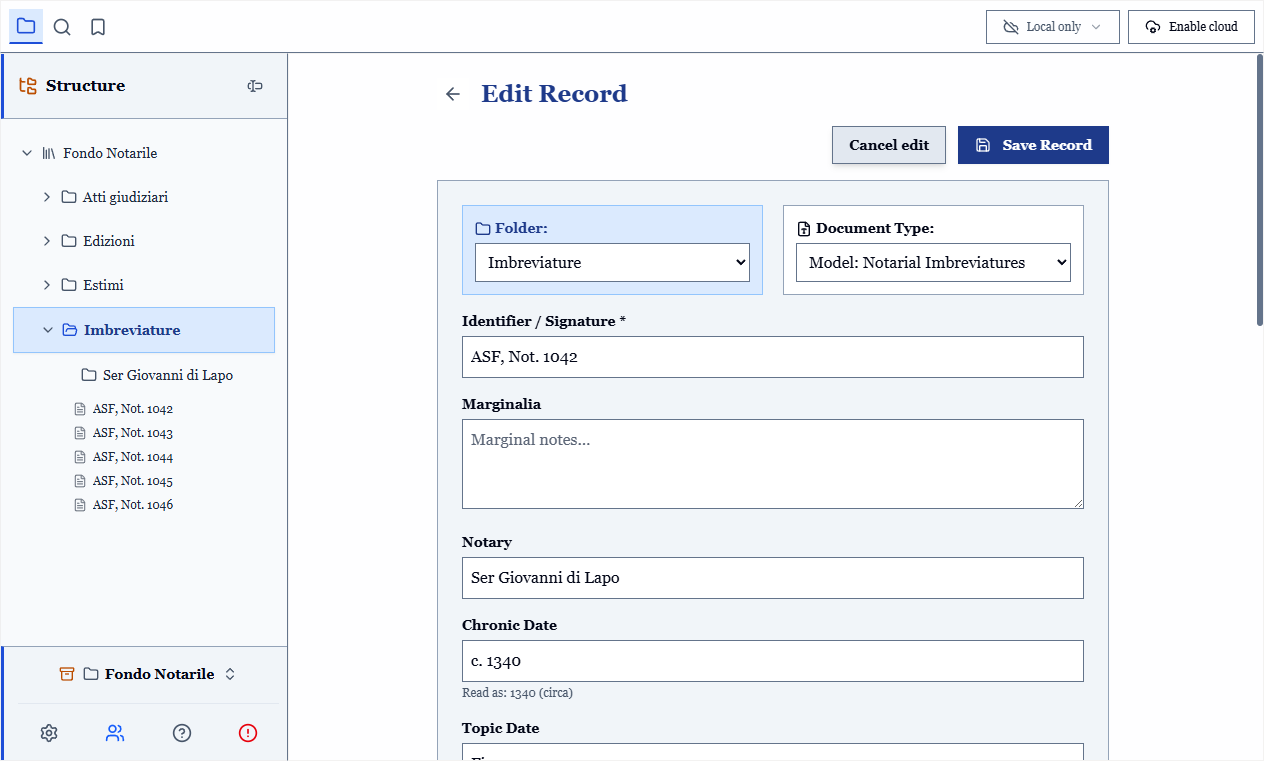
Write it as you would in a calendar or summary. The program recognises the Italian and Latin archival conventions it was built for:
| Form | Examples |
|---|---|
| Full date | 12 maggio 1340, 1340 maggio 12, 12/05/1340, Latin month names included |
| Year only | 1340 |
| Month and year | maggio 1340 |
| Approximation | c. 1340, ca. 1340, circa 1340, verso il 1340, intorno al 1340 |
| Terminus ante quem | ante 1350, prima del 1350 |
| Terminus post quem | post 1330, dopo il 1330 |
| Range | 1340-1345, 1340-45, tra il 1340 e il 1345 |
| Century | sec. XIV, sec. XIV in., sec. XIV ex., sec. XIV med., first and second half |
| Undated | s.d. |
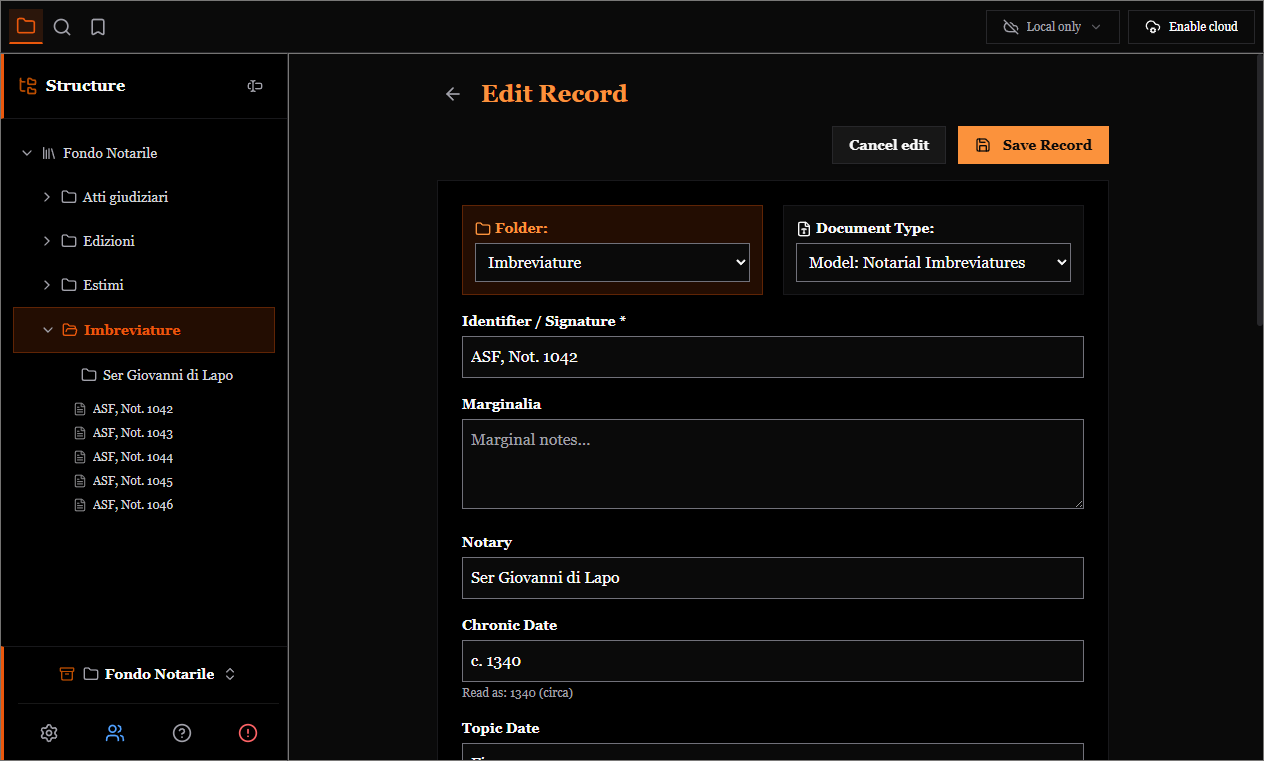
Below the field, as you type, the program states how it read what you wrote. It is the most useful part of the feature: you check straight away whether sorting will place the record where you expect.
What is not recognised
It is not guessed. A dating the program does not understand stays plain text: it takes no part in chronological sorting (it goes to the end, in both directions) and does not answer period filters.
This is deliberate: an invented range would enter sorting as if it were certain data. If you need a dating to be sortable and the program does not recognise it, rephrase it in one of the forms above.
Sorting chronologically
In the list you can sort by the date field: records are arranged in true chronological order, not alphabetical. Without this interpretation "12 maggio 1340" would come before "3 aprile 1290", because 1 comes before 3.
Datings with only an ante term are sorted on their end, since they have no beginning: otherwise they would sit at the top of the archive together with the oldest documents.
Filtering by period
In the advanced filters you can ask for a range of years or a century.
The criterion is overlap, not containment: when searching the fourteenth century, a record dated 1290-1310 does appear. Excluding it would hide precisely the documents that straddle the boundary, which are usually the ones you are looking for.
Two different filters, not to be confused
Document period = when the document was written. Modification date = when you last touched the record. They are two distinct filters, with different icons and headings.
Details
circadoes not widen the range by five years: it is a declared uncertainty, not a quantity nobody wrote.- The interpretation is not saved in the record: the database keeps the text you typed. If recognition improves in a future version, your records will benefit without you having to correct them.
- A document type with no date field never appears in the results of a period filter: showing it would amount to claiming that the record is from the fourteenth century without knowing it.